Best Matter Smart Home Hub 2026: The Comprehensive Buyer’s & Architect’s Guide
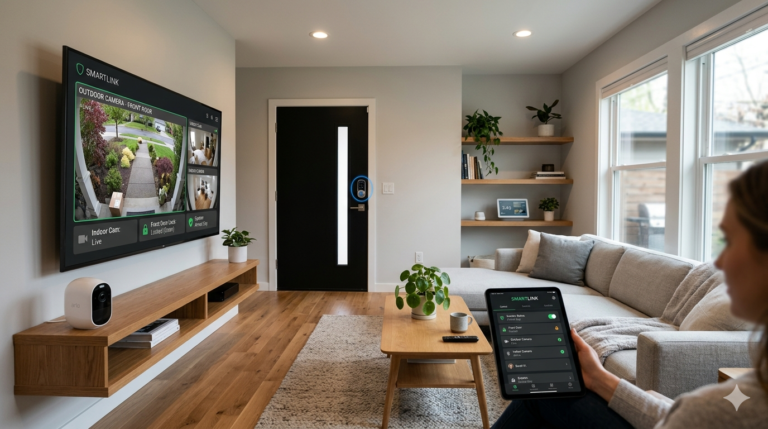
Finding the best matter smart home hub 2026 setup allows you to seamlessly unify all your smart lights, security cameras, contact sensors, and thermostats across Apple Home, Google Home, Amazon Alexa, and SmartThings ecosystems without brand lock-in. As home automation technology reaches maturity, eliminating vendor fragmentation, cloud reliance, and lagging multi-app setups has become the highest priority for modern homeowners.
Modern Matter hubs provide edge-based local execution, ultra-low latency, and reliable multi-admin control. This guarantees that your automated home routines keep running smoothly even during broadband outages or cloud service disconnections. Whether you are assembling a zero-subscription DIY security ecosystem or building complex multi-room lighting routines, selecting the proper central controller dictates the long-term speed, stability, and security of your home network.
Table of Contents
ToggleWhy You Need the Best Matter Smart Home Hub 2026
Choosing the best matter smart home hub 2026 eliminates the headache of maintaining walled gardens where smart peripherals refuse to talk to each other. In earlier smart home eras, purchasing a smart camera, motion sensor, or smart lock locked you into a single proprietary app or required complex custom integrations. The Connectivity Standards Alliance (CSA) Matter protocol solved this by standardizing local IP-based communication across all major technology platforms.
When you integrate the best matter smart home hub 2026 as your primary gateway, your automation routines process on your local local area network (LAN) rather than routing back and forth over remote cloud servers. Local execution cuts response latency from over half a second down to tens of milliseconds while shielding your private device logs from third-party tracking.
+-----------------------------------------------------------------------------------+
|                        MATTER MULTI-ADMIN ARCHITECTURE                            |
+-----------------------------------------------------------------------------------+
|  [Apple Home App]    <--->    [Google Home App]    <--->    [Amazon Alexa App]    |
|       (iOS)                      (Android)                     (Voice)            |
|                                      |                                            |
|                  ( Concurrent Multi-Admin Control )                               |
|                                      v                                            |
|                   [ Central Matter Hub & Thread Gateway ]                         |
|                                      |                                            |
|        +-----------------------------+-----------------------------+              |
|        v                             v                             v              |
| [Thread Mesh Devices]      [Wi-Fi Matter Cameras]      [Zigbee / Z-Wave Bridge]   |
| (Sensors, Plugs, Locks)    (Local 2K/4K Streams)       (Legacy Sensors & Dimmers) |
+-----------------------------------------------------------------------------------+
Core Technologies Defining 2026 Matter Controllers
Evaluating the best matter smart home hub 2026 options requires understanding the three core roles a modern hub performs:
1. Matter Controller
The hub serves as the brain that commissions, manages, and executes rules for Matter-native accessories on your local Wi-Fi, Ethernet, or Thread networks.
2. Thread Border Router
Thread is a low-power, self-healing mesh networking protocol engineered specifically for battery-operated accessories like door sensors and smart locks. A hub equipped with a Thread Border Router bridges these low-power radios directly to your main IP home network.
3. Matter Bridge
If you own existing Zigbee, Z-Wave, or sub-GHz devices, a Matter Bridge translates those legacy signals into standard Matter endpoints. This allows your older $15 Zigbee door sensors or Z-Wave light switches to show up natively inside modern platforms like Apple Home or Google Home without buying new hardware.
Key Features to Look For in a Matter Hub
To select the best matter smart home hub 2026 for your property size and technical skill level, focus on these five core benchmarks:
- Integrated Thread Border Router: Ensure the hub supports Thread 1.3 or 1.4 specs to build an interconnected mesh network across all rooms.
- Physical Ethernet Connection (PoE Preferred): Hardwired Ethernet provides continuous network stability, eliminating Wi-Fi dropouts and roaming latency. Power over Ethernet (PoE) allows single-cable deployment on walls or ceilings.
- Multi-Admin Sharing: True Matter compliance allows you to share control of connected devices across different family members’ devices, whether they use iOS or Android.
- Local Routine Processing: Ensure that rule processing (e.g., “If motion detected after 10 PM, turn on hallway light”) executes on the hardware itself, requiring zero active internet connections.
- Legacy Radio Support: Having Zigbee 3.0 or Z-Wave radios built into your hub guarantees broad compatibility with affordable sub-devices.
In-Depth Breakdown of Top Matter Hubs in 2026
| Hardware Model | Best For | Radio Protocols | Local Control Level | Power Input | Skill Level Needed |
| Home Assistant Green | Privacy purists & power users | Matter, Thread (via dongle), Wi-Fi, BT | 100% Fully Local | 12V DC Adapter | Intermediate to Advanced |
| Aqara Hub M3 | Sensor setups & cross-brand bridging | Matter, Thread, Zigbee 3.0, IR, Wi-Fi | Edge-Local | USB-C or PoE (48V) | Beginner to Intermediate |
| Homey Pro (2026) | Whole-home luxury & non-coders | Matter, Thread, Zigbee, Z-Wave, 433MHz, BT | 100% Fully Local | USB-C Adapter | Intermediate |
| Apple TV 4K (128GB) | Apple-centric homes & media setups | Matter, Thread, Wi-Fi, Bluetooth | High Local Execution | Standard AC Power | Beginner / Plug-and-Play |
Detailed Model Analysis
1. Home Assistant Green
- Overview: The premiere open-source gateway for users who demand total control over their data without any cloud telemetry.
- Strengths: Processes every single automation on local hardware. Supports hundreds of thousands of integrations, deep custom dashboards, and comprehensive diagnostics.
- Weaknesses: Requires a USB SkyConnect / Connect ZBT-1 dongle to add Thread and Zigbee radios; steeper learning curve than off-the-shelf consumer apps.
2. Aqara Hub M3
- Overview: The most versatile sub-$150 multi-protocol bridge on the market.
- Strengths: Features built-in Power over Ethernet (PoE), an integrated 360-degree IR blaster for controlling legacy AC units/TVs, and native Thread Border Routing. Serves as a transparent Matter bridge for up to 127 Aqara Zigbee accessories.
- Weaknesses: Advanced custom scene triggers like zone-based presence must still be configured within the primary Aqara application.
3. Homey Pro (2026 Edition)
- Overview: The ultimate high-end, multi-radio hub designed for large properties with diverse smart tech.
- Strengths: Includes onboard Z-Wave, Zigbee, Thread, Matter, and 433MHz transmitters. Offers an intuitive drag-and-drop flow builder that simplifies complex logic without writing code.
- Weaknesses: High upfront cost compared to basic streaming box hubs.
Step-by-Step Installation & Configuration Guide
Deploying the best matter smart home hub 2026 setup across your property takes less than thirty minutes when following this sequence:
- Determine Placement Location: Position your hub in a elevated, central area of your home. Keep it away from large metal enclosures, thick concrete structures, or high-power Wi-Fi routers to prevent 2.4GHz radio frequency interference.
- Establish Hardwired Network Power: Connect an RJ45 Ethernet cable directly from your mesh node or switch to the hub’s LAN port to minimize network jitter.
- Power On the Unit: Supply power via USB-C or PoE depending on your hardware model.
- Commission inside Primary Ecosystem App: Open your chosen app (e.g., Apple Home, Google Home, SmartThings, or Home Assistant). Select Add Accessory, scan the unique 11-digit Matter setup QR code printed on the bottom of the device, and follow the prompt to register it on your LAN.
- Form Your Thread Mesh Network: As you add battery-powered Thread contact sensors or plug-in Thread smart plugs, they will automatically pair to your hub’s Thread Border Router, forming a self-healing mesh that expands coverage across long distances.
- Activate Multi-Admin Mode: To allow family members on Android phones to control accessories configured on an iPhone, generate a new Matter sharing code in your primary app’s setting panel and input it into the second platform’s app.
Common Installation Pitfalls to Avoid
- Relying Exclusively on Wi-Fi: Wireless backhaul can induce unexpected latency during heavy network usage. Always prefer direct Ethernet cabling for central controllers.
- Frequency Overlap on 2.4GHz: Both Zigbee and Thread share the 2.4GHz spectrum alongside standard Wi-Fi channels. Configure your home router to fixed Wi-Fi channels 1 or 6, allowing Thread and Zigbee to operate cleanly on channel 25 or 26.
- Over-reliance on Cloud Automations: Ensure that critical safety automations (such as water leak shut-off valves or security sirens) are set to execute locally on the hub rather than triggering through third-party cloud webhooks.
Final Thoughts: Building a Future-Proof Network
Investing in the best matter smart home hub 2026 brings complete harmony, privacy, and speed to your home automation environment. By routing your smart cameras, sensors, lighting, and entry access controls through a dedicated edge controller, you remove subscription fees, avoid vendor lock-in, and build an adaptable home network that operates reliably for years to come.