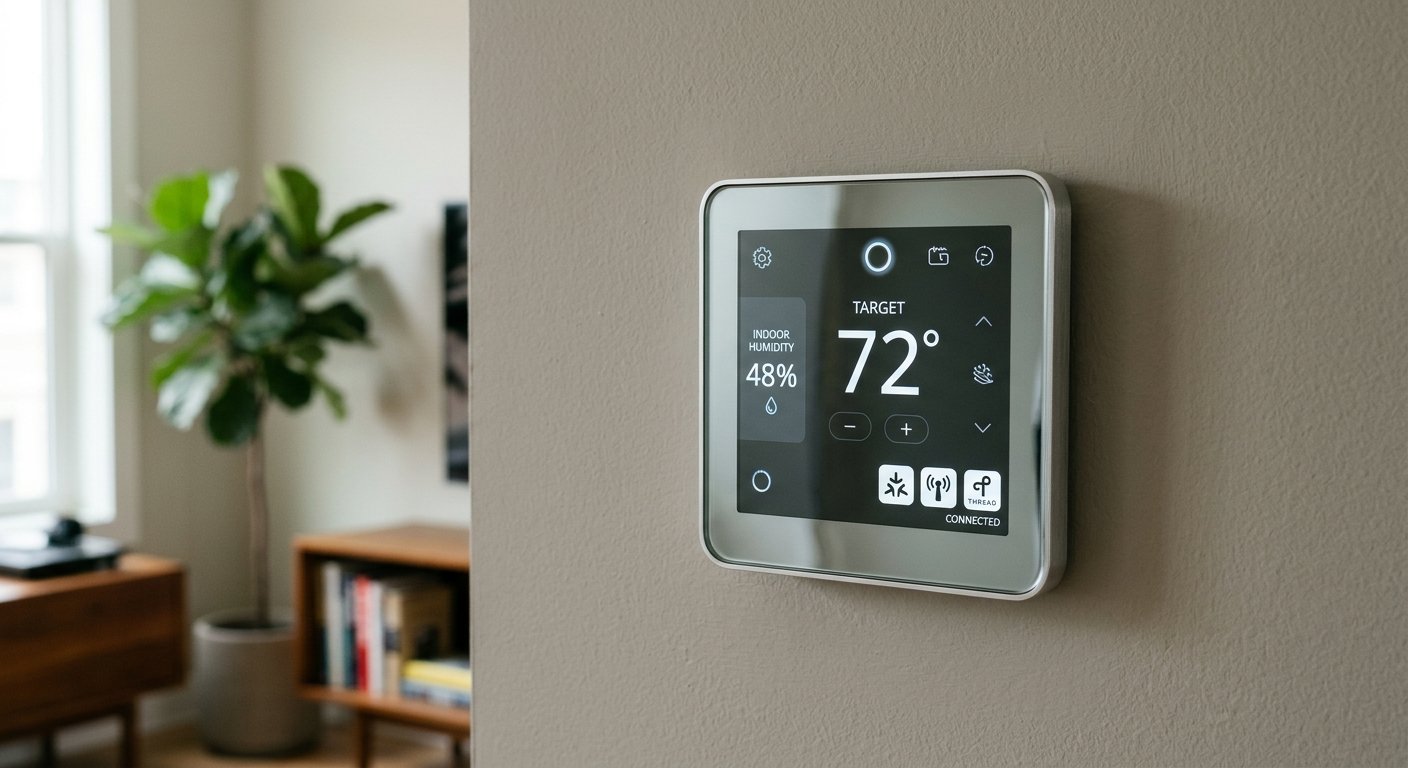
Why Local Smart Thermostats Are Essential in 2026
Bottom Line Up Front (BLUF): Installing a smart thermostat no subscription device is the most efficient upgrade you can make to lower household utility bills and enhance comfort in 2026. By utilizing local Matter over Thread protocols and local machine-learning algorithms, these thermostats automate HVAC schedules based on occupancy and weather patterns with zero recurring subscription fees.
Heating and cooling account for over 50% of an average home’s total energy consumption. While early smart thermostats promised big savings, many modern brands slowly pushed critical features—like long-term temperature history, remote room sensor scheduling, and predictive pre-cooling—behind mandatory monthly cloud subscriptions.
A modern smart thermostat no subscription setup eliminates cloud fees entirely. Equipped with onboard scheduling chips and open local connectivity, these devices run intelligent thermal automations directly within your local smart home network, keeping your data private while saving you hundreds of dollars on annual energy bills.
Table of Contents
ToggleKey Benefits of Subscription-Free HVAC Automation
- Sub-Second Local Automations: Adjust climate rules instantly when local presence sensors detect room occupancy or open windows.
- Integrated Remote Room Sensors: Balance hot and cold spots across bedrooms and home offices using wireless battery-powered temperature nodes.
- 100% Offline Capability: Saved heating and cooling schedules continue running seamlessly even during internet service outages.
- Complete Household Privacy: Prevent utility companies and external cloud vendors from tracking your daily wake, sleep, and occupancy habits.
3 Features to Check Before Buying a Smart Thermostat
1. Onboard NDIR Humidity & Temperature Sensing
Choose hardware with high-precision internal sensors that adjust setpoints based on the heat index (temperature + humidity) rather than basic dry-bulb measurements alone.
2. Native Matter over Thread Protocol
Selecting a smart thermostat no subscription unit with native Matter over Thread support guarantees local mesh communication across Apple Home, Google Home, SmartThings, and Home Assistant without cloud delay.
3. C-Wire Adapter or Power Extender Kit Included
Ensure the thermostat package includes a C-wire adapter kit so older 4-wire HVAC systems can deliver constant 24V power without relying on battery draining tricks.
Comparison: Local Matter Thermostat vs. Legacy Cloud Thermostat
| System Feature | Local Matter Thermostat (No Subscription) | Legacy Cloud Thermostat |
|---|---|---|
| Control Architecture | Local Mesh (Thread / Zigbee) | Vendor Cloud Server (Delayed) |
| Multi-Room Sensor Support | Included Built-In ($0/mo) | Often Locked Behind Cloud Tier |
| Internet Outage Resiliency | Schedules run 100% locally | Fails or reverts to manual override |
| 5-Year Operating Cost | $0 | $120 – $300+ in cloud access fees |
Building an Efficient, Subscription-Free Smart Home
Pairing a smart thermostat no subscription model with local mmWave presence sensors and smart window shade openers allows you to build an intelligent, energy-saving ecosystem. For more hardware reviews, setup tutorials, and subscription-free security guides, visit our home page at SystemForHome. To learn more about official residential HVAC efficiency standards, consult the official Energy Star Home Heating & Cooling Guide.
More Tips for Optimizing Smart HVAC Performance
To get the highest return on investment from your subscription-free thermostat, implement these practical efficiency strategies:
- Set 1-Degree Setpoint Differences: Setting your thermostat 1 to 2 degrees higher in summer or lower in winter can reduce your seasonal HVAC electricity draw by up to 10%.
- Automate Around Time-of-Use (TOU) Rates: Pre-cool or pre-heat your home 1 hour before peak energy rate windows begin to avoid expensive peak-hour grid pricing.
- Pair with Open Window Sensors: Create a local automation that turns off the HVAC compressor automatically whenever a balcony door or window remains open for longer than 3 minutes.
- Replace Furnace Filters Bi-Monthly: Clean air filters prevent airflow restriction, keeping system pressure low and motor performance high.
How to Install Your Smart Thermostat in 4 Steps
- Power Off Main Breaker: Turn off electrical power to your HVAC furnace and air handler unit before touching any wiring.
- Label Existing Thermostat Wires: Remove the old faceplate and label the wires (R, C, Y, G, W) using the included wiring stickers.
- Mount Backplate & Wire Terminals: Attach the new backplate to the wall and insert each labeled wire into its matching push-terminal block.
- Pair to Local Network: Restore power, scan the Matter QR code on the thermostat display, and pair it directly to your local smart home hub over Thread.
Frequently Asked Questions
Do smart thermostats require a C-wire?
Most modern smart thermostats need a 24V C-wire (Common Wire) for constant power. If your wall lacks a C-wire, you can easily install the C-wire adapter included in most thermostat kits inside your furnace panel.
Can a smart thermostat work without Wi-Fi?
Yes. Matter over Thread and Zigbee thermostats maintain full local communication with your local hub and satellite sensors even if your home loses external internet access.
Final Verdict
Upgrading to a smart thermostat no subscription model gives you complete automated control over your indoor climate, lower monthly power bills, and absolute privacy—all with $0 in recurring fees.